 73 Quasars in a LQG comprise the largest fundamental structure in the known universe. Plasma cosmology explains and predicts larger structures than the big-bang theory does. Electromagnetic jets collectively interacting over 1.6 billion light years apart in the large quasar group, become twisted by magnetic fields into Birkeland current filaments, that carry moving charges by the fundamental forces that produce cosmic scale electricity and magnetism. |
The size in meters of the Large Quasar Group is 10^115 power in orders of magnitude by length.


 |
| 73 quasars form the largest known structure, falsifying all kinds of phony dark matter theories required in the big-bang. (Sci-news feature story) |

 |
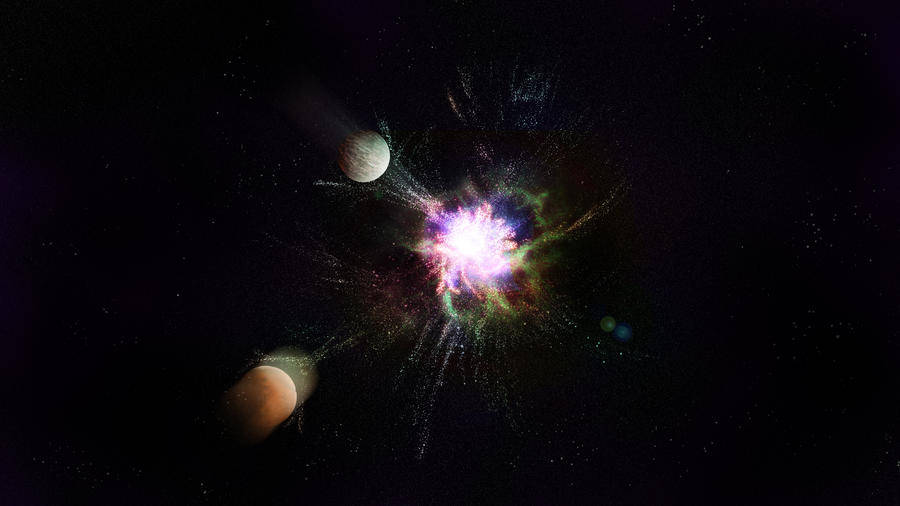
| Fractal Quasar |

Only 73 quasars in a group stretches farther than the Sloan great wall of galaxies, and hyperclusters. 5% of the visible universe alone is supposedly contained inside a single supercluster, the Sloan great wall filament that spans 2.5 billion light years across. Hyperclusters discovered by Shawn Thomas are over 3 billion light years long. With only 14 1/2 billion years of time, crammed together in a small space called the visible universe, these enormous highly organized and ordered fractal cosmic structures, would not have had enough time to have formed.


Roger Clowes and team members discovered that the 73 quasars are mostly 1.6 billion light years across from each other, and 4 billion light years apart their farthest distances. This defies Einstein's cosmological principle upon which the big-bang theory is founded, because the universe is not essentially homogeneous at larger scales as predicted.


"A structure in the early universe at Z ~ 1.3 that exceeds the homogeneity scale of the R-W concordance cosmology" by Roger Clowes (The entire full paper version by Roger Clowes at the monthly astronomical society) Clowes writes about a "precursory supercluster" that might be forming, to comply with current cosmological thinking. It should seem obvious that the "precursory supercluster", that contains more mass than anything else in the universe, would require tens of billions of years at least to form, suggesting that the big-bang wasn't so big after all.
Highly ordered self-similar fractal galaxy structures called "hyperclusters" require well over 100 billion years to form in their entirety.
Hyperclusters stretching 3 billion light years challenges the big-bang theory.
A great blog to join is Paranormalis.com - What's the biggest structure known to man in the universe? You'll be receiving more updates by email whenever the next record breaking largest cosmic structure is discovered.
Interview of Roger Clowes who says Einstein's cosmological principle has never been proven beyond a reasonable doubt. In fact, it becomes highly questionable, because the universe must be older than 100 billion years, according to correct interpretations of new findings.


 |
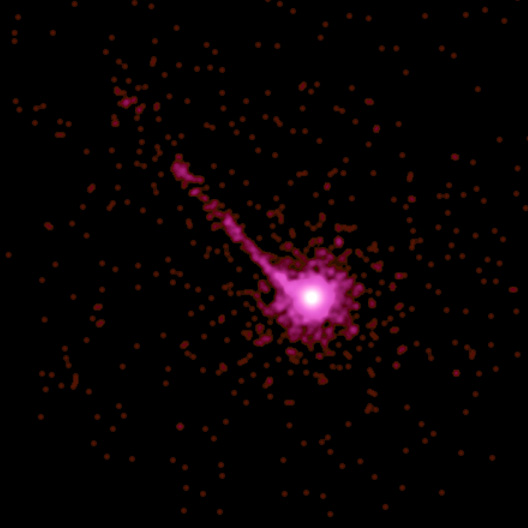
| Quasar GB 1428 X-ray jet is over 230,000 light years long |
 Quasar
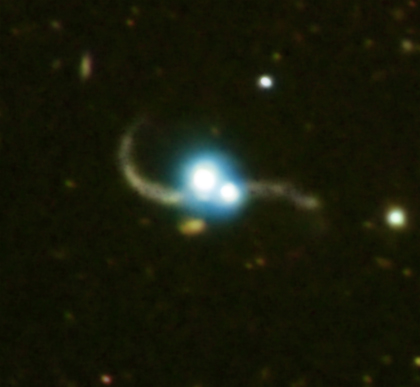 |
| Binary Quasar |

A Hypercluster filament with large bright distant ancient quasar groups, and younger galaxies. The New Fractal Universe Model |
| Quasar groups are the largest, oldest, and most distant energetic known structures in the universe. This new fractal cosmological model best explains the findings. Ancient Quasar groups are interconnected by filaments. Galaxy clusters are connected to quasar groups by filaments. When filaments break, magnetic reconnection occurs. Galaxies have interconnecting filaments to galaxy groups that connect to galaxy clusters. Galaxies are orbiting in a plasma vortex state |


No comments:
Post a Comment